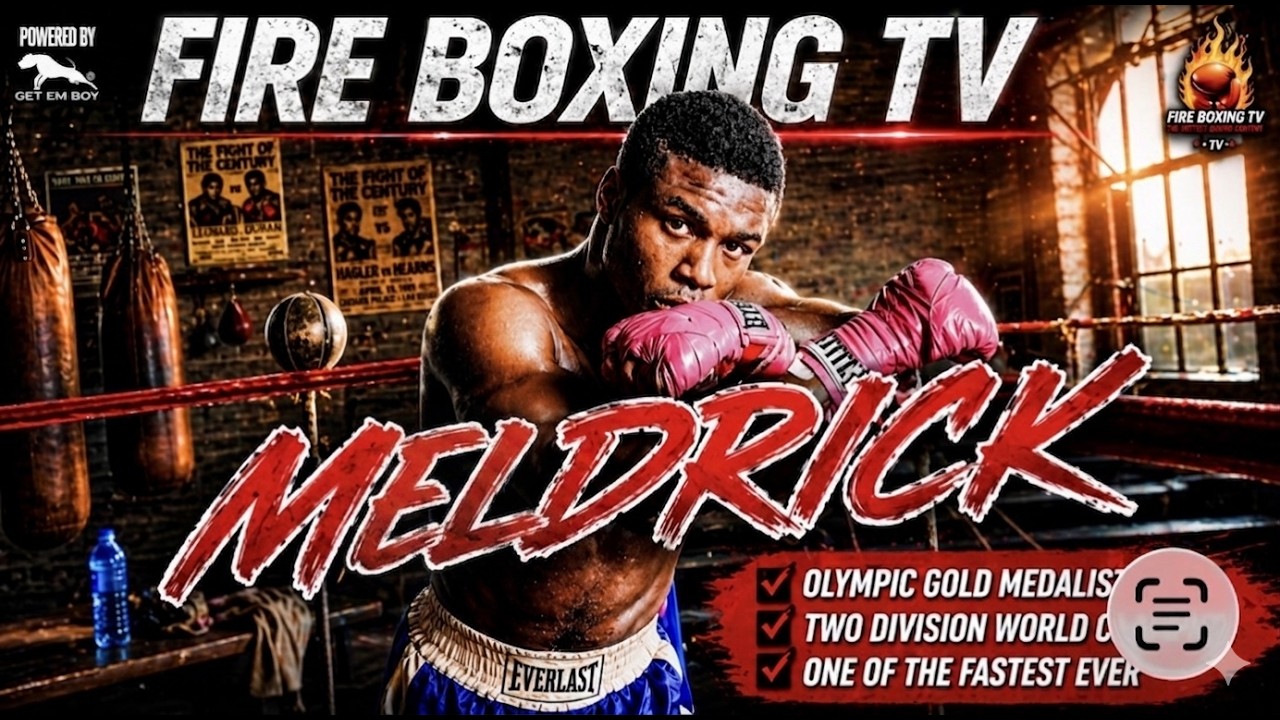
The Blur of Philly: The Transcendent Speed and Heartbreaking Sacrifice of Meldrick Taylor
A deep dive into the legendary career of Meldrick Taylor, exploring his meteoric rise to Olympic gold and the haunting night in Las Vegas that changed everything.
The Fastest Hands in the History of the Sweet Science
In the long, storied history of Philadelphia boxing, a city synonymous with grit, chin, and blue-collar toughness, one name stands out as a literal blur of kinetic energy: Meldrick Taylor. Known as "The Kid," Taylor didn’t just box; he operated at a frequency that seemed to defy the laws of physics. His hand speed was not merely fast—it was hallucinogenic. Opponents would often find themselves hit by four-punch combinations before they could even register the first jab. However, as the latest Fire Boxing TV (FBTV) mini-documentary explores, the very attributes that made Taylor a phenom—his blinding speed and his refusal to back down—ultimately led to one of the most heartbreaking narratives in the sport's history.
At Fire Boxing TV, we always keep it a stack. We aren't just here to celebrate the knockouts; we are here to analyze the soul of the fighter and the brutal realities of the squared circle. Meldrick Taylor’s story is the ultimate testament to the dual nature of boxing: the intoxicating glory of the ascent and the devastating, quiet tragedy of the decline. To understand Taylor, you have to understand the environment that forged him. North Philly gyms are not for the faint of heart. They are pressure cookers where technical brilliance is expected and toughness is a prerequisite. Taylor emerged from this environment not just as a prospect, but as a prodigy.
From Olympic Gold to Professional Dominance
The journey began in the pressure cooker of the North Philly gyms, but Meldrick Taylor truly burst onto the global stage as a teenager. As a standout member of the 1984 U.S. Olympic boxing team—widely considered the greatest amateur squad ever assembled—Taylor captured gold in Los Angeles at just 17 years old. He shared that stage with icons like Evander Holyfield, Pernell Whitaker, and Mark Breland, yet many observers felt Taylor possessed the highest ceiling of them all. His amateur pedigree was flawless, showcasing a maturity in the ring that belied his age.
Transitioning to the professional ranks, Taylor brought a refined version of the "Philly Shell" combined with an offensive output that was unprecedented. His ring IQ allowed him to navigate the pocket with impunity, utilizing subtle head movement and lateral footwork to create angles that left seasoned veterans swinging at ghosts. By the time he captured the IBF light welterweight title from Buddy McGirt in 1988, Taylor looked invincible. He was the quintessential boxer-puncher, a whirlwind of leather that promised a long, dominant reign at the top of the pound-for-pound rankings. Against McGirt, a master technician in his own right, Taylor’s speed was the deciding factor, forcing a stoppage that signaled the arrival of a new era.
Thunder vs. Lightning: The Night the Clock Stopped
Every legendary fighter has a defining night, and for Meldrick Taylor, that night was March 17, 1990. It was "Thunder vs. Lightning" at the Hilton in Las Vegas—a unification clash between Taylor and the relentless Mexican icon Julio César Chávez. As the FBTV documentary meticulously breaks down, this wasn't just a fight; it was a high-speed collision of two diametrically opposed philosophies of the sweet science. Taylor was the lightning, a flurry of activity; Chavez was the thunder, a slow-rolling storm that eventually levels everything in its path.
For eleven rounds, Taylor put on a masterclass. He outworked Chávez, peppering the Mexican legend with blistering flurries and showcasing a level of conditioning that seemed superhuman. To the naked eye, Taylor was winning handily, sweeping the early and middle rounds with sheer volume. However, Chávez was playing a longer, more sinister game. The "Greatest Mexican Warrior" was investing in the body, landing thudding shots that slowly sapped Taylor’s vitality, even as Taylor continued to lead on the scorecards. The damage was cumulative, hidden behind Taylor's rapid-fire responses.
The final round of that encounter remains the most debated three minutes in boxing history. With Taylor visibly broken, spitting blood and suffering from internal damage, Chávez landed a devastating right hand that dropped the Philly legend with seconds to go. Taylor rose at the count of six, but referee Richard Steele, seeing Taylor’s glazed eyes and lack of response to his commands, waved the fight off with just two seconds remaining on the clock. It was a technical knockout that stunned the world and effectively ended the "prime" of Meldrick Taylor. The controversy of the stoppage would linger for decades, but the physical toll was immediate and irreversible.
The Physical Toll and the Price of Valor
While the controversy of the Steele stoppage dominates the headlines, the FBTV analysis looks deeper into the physical aftermath. Post-fight reports indicated that Taylor had swallowed nearly two pints of his own blood, suffered a fracture to his orbital bone, and was experiencing acute renal failure. He gave his physical prime to those twelve rounds. As Tick Boom Tha Don emphasizes in the documentary, boxing is a sport where you don't just lose a fight; you lose a piece of yourself. The sheer volume of punches Taylor threw and absorbed that night would have retired a lesser man on the spot.
The Meldrick Taylor who returned to the ring after the Chávez war was a shadow of the "Lightning" that had once dazzled the world. His timing was off, his reflexes had slowed, and that trademark Philly chin began to fail him. Despite winning another world title at welterweight against Aaron Davis, the decline was evident to anyone who truly understood the sport. The volume was there, but the rhythm was gone. The fluidity that made him a phenom had been replaced by a mechanical, labored style.
- Loss of Reflexes: The split-second timing required for Taylor's style vanished after the trauma of the 1990 war.
- Speech Impairment: In later years, Taylor began to exhibit the tragic symptoms of CTE, with his once-clear speech becoming heavily slurred—a sobering reminder of the sport's darker side.
- The Psychological Impact: The controversial nature of his greatest loss left a lingering "what if" that haunted Taylor's subsequent performances and his relationship with the sport.
Legacy of a Philly Legend
Today, Meldrick Taylor is often remembered as a cautionary tale, but that does a disservice to his incredible skill set. At FBTV, we believe in giving a fighter his flowers while also being honest about the thorns. Taylor was a virtuoso who chose to fight with the heart of a brawler. He didn't have to stay in the pocket against Chávez; he chose to, driven by a Philly-bred need to prove his toughness. That courage is what made him a legend, and it is also what led to his premature exit from the elite level of the sport. He was a fighter who refused to take the easy way out, even when his talent gave him every opportunity to do so.
His legacy is one of pure, unadulterated talent. When we talk about the fastest hands in boxing history, Taylor’s name must be mentioned alongside Roy Jones Jr. and Sugar Ray Leonard. He was a pioneer of high-volume tactical pressure, and his influence can still be seen in the modern era of the 140 and 147-pound divisions. He remains a hero in Philadelphia, a symbol of the city's uncompromising boxing spirit.
Watch the Full Mini-Doc on Fire Boxing TV
To truly understand the technical nuances of Taylor’s footwork and the heartbreaking final seconds of the Chávez fight, you need to see the footage. Our latest mini-doc provides a visual breakdown of the rise and fall of this Olympic hero. We go beyond the surface-level highlights to show you the man behind the gloves—the sacrifices, the triumphs, and the harsh realities of life after the final bell. We analyze the tape to show you exactly how the "Lightning" was eventually caught by the "Thunder."
Boxing is the most beautiful and brutal sport on earth. At Fire Boxing TV, we are committed to bringing you the unabashed truth about the warriors who step inside the ropes. Don't miss this deep dive into the life of a true Philly great. Watch the full video now on YouTube: "FBTV - MELDRICK (mini doc)" and make sure to SUBSCRIBE to Fire Boxing TV for more elite boxing content, history, and analysis. We keep it a stack, every single time.